
Brora, Part 1
Revelations from the Rim of the World

BRORA GOLF CLUB
BRORA, SCOTLAND
GREENS FEE: £140
DATE PLAYED: OCTOBER 7, 2024
The ninth green at Brora Golf Club sits at latitude 58 degrees north, two minutes, and 7.3 seconds. Directly east, the same parallel runs through southern Sweden and passes 160 miles north of Moscow. Westward, the parallel moves across northeastern Canada’s Hudson Bay and through Juneau, Alaska.
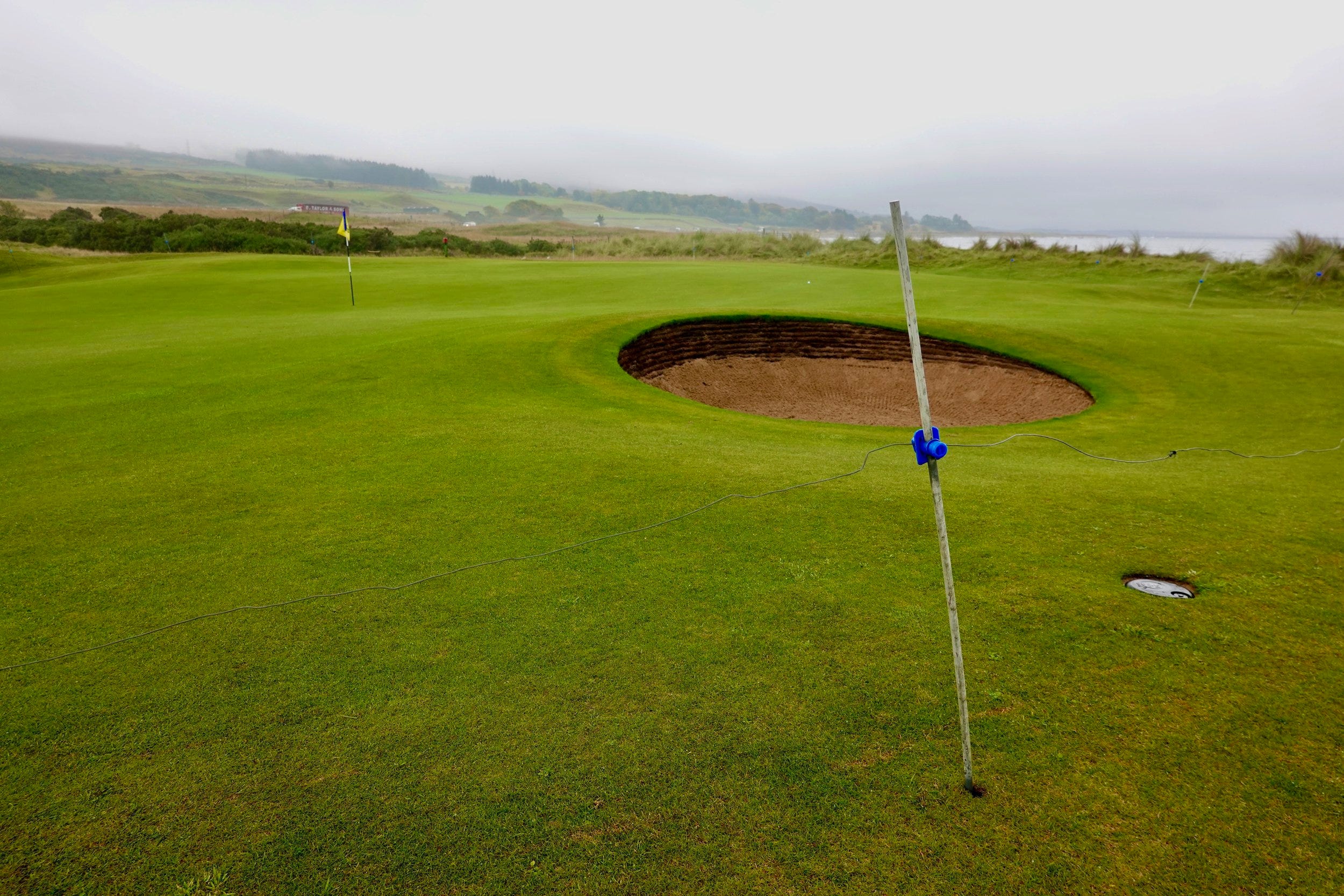
The green marks Brora’s northernmost point, perched just above the Moray Firth, separated from the beach by little more than a strip of native grass. To its left, a sand trap guarding the high side of the ninth hole’s two-tiered green, and a walking path to the 10th teebox. To the green’s right, nothing but the North Sea until you hit Norway. It is closer to the North Pole than it is to Boston.
It is the farthest north on this planet I’ve ever been.
There is something wistful about the Scottish Highlands — nearly sad, but not quite; beautiful, but lonely. Nowhere more so than here. On a cold, windy day, with grey clouds looming overhead and east Sutherland’s ancient hills in the distance, the ninth green’s perch looks like the oldest place in the world — the firstborn of all creation, its age laid fully bare without even a year unmarked. Yet it is also damp and green and alive and renewed, suffering the unceasing waves but enduring them.
It is an easy place to feel small and momentary. But it also is an easy place to feel at peace and part of something eternal. There is a fine line between them. Brora straddles it. I’d come to Scotland looking for something — a revelation, maybe. Something wild and undiscovered; primal, essential. A place closer to God, if He’s out there somewhere.
I didn’t know it until I saw it, but I’d been looking for Brora all along.
. . .
You know that you’re on a journey, rather than a mere vacation, when you set your alarm at night. Mine went off at 6:30 a.m. Dull, grey clouds held back the sunrise in Golspie, a small Highlands town where I’d spent two nights and played its James Braid-designed golf course the day before. Rain pattered against my bedroom’s cold windowpane. I fumbled for my phone and snuffed out the alarm. It was Monday morning. I’d be leaving soon.
The bed and breakfast that I’d called home for the past 36 hours had been everything that I’d needed: a quiet room, a clean bed, a hot shower, and more breakfast than you could stuff into an airplane carry-on. And the town’s famous golf course, while not the greatest four hours of my life, had been eye-opening. But I was ready to move on. One round of golf at Golspie had been enough for this trip, and I couldn’t drop in the chip shop again without hearing from my cardiologist.
British food gets a bad rep. It’s predictable. But it’s a little like Boston’s Greatest Hits: sure, it’s the same song over and over, but I like that song. Dinner is fried meat and fried carbs. More importantly, so is the full Scottish breakfast: bacon (more like thick ham), sausage, eggs, haggis, pan-simmered mushrooms, sliced tomatoes, and baked beans. “Would you like to start with cereal,” my host asked, “or move straight to breakfast?” Any country that treats cereal as an appetizer is my kind of place. I graciously accepted a bowl of Frosted Flakes and a French press of coffee for the first 400 hundred of my 2,000-calorie jumpstart.
A few minutes after 9, I thanked my hosts and headed out the door, suitcase and travel golf bag in tow. It was raining, but the Scotrail station was only a two-minute walk. After a short wait under an overhang, the train pulled into the station on time. Ten minutes later, I was in Brora, the northernmost port on my journey.
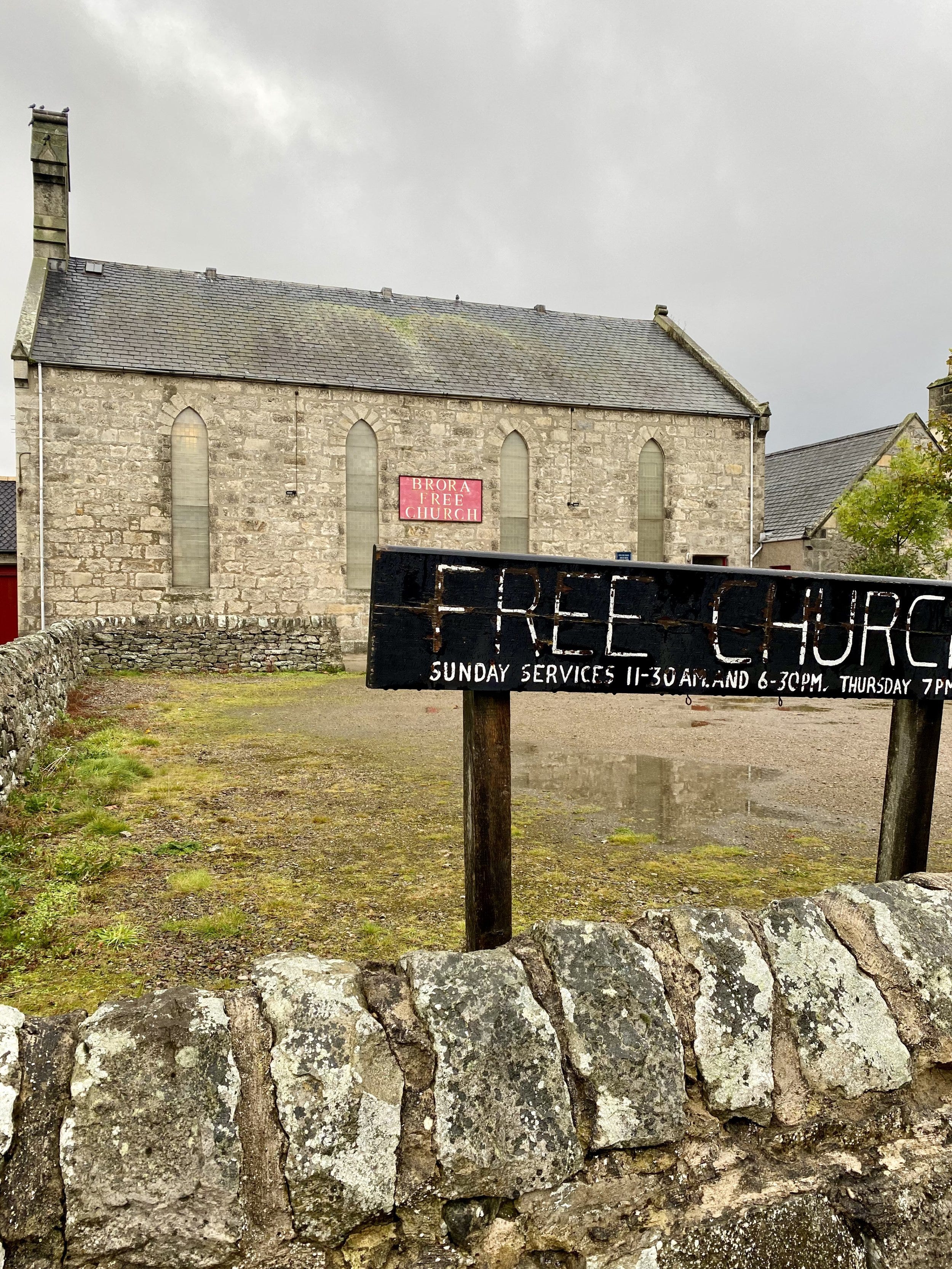
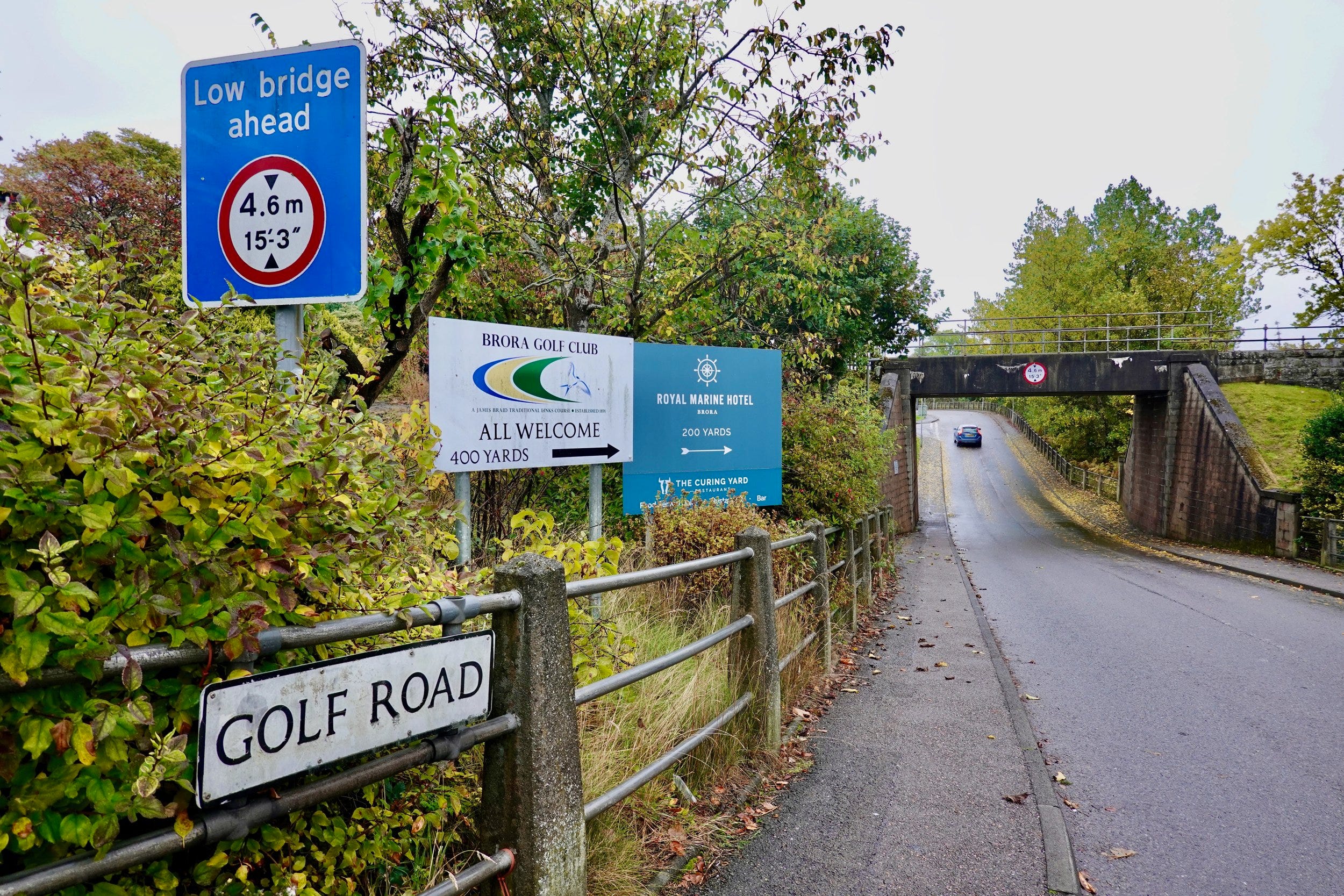
Brora is a more charming town than hardscrabble Golspie. The River Brora, which forms from the convergence of two smaller streams 10 miles to the northwest, meanders through the center of town and finishes its journey to the sea at Brora Beach, a 6-iron south of the golf course’s first tee. Coffee shops, bakeries, homes, and gardens line the A9, and a 50-foot stone memorial bearing the names of Brora’s war dead overlooks the river. And a 10-minute walk from the Scotrail station, the small town’s revelation of a golf course. The town would have to wait. Early or not, it was time to head to the course.
After checking in, and with time to spare before teeing off, I headed upstairs to the clubhouse restaurant for a cup of coffee and a muffin to shake off the cold and rain. But I spent nearly every minute gawking at the 18th green — a long, sadistic par-3 (201 yards from the back white tees, 190 yards from the middle yellow tees) with a a cavernous, 40-yards-long swale fronting the green, bunkers right and a steep falloff to the left, and an inhumane false front. I couldn’t take my eyes off it, long after I’d drained my coffee.
But tee times wait for no one. After about 10 minutes of putting and another five of bashing irons into a practice net, I headed to the first tee to meet my caddie, wind and rain be damned.
. . .
When golf architecture minimalists lecture the masses on finding a piece of ground and letting it speak for itself, Brora is what they mean. It is a masterclass in an architect not getting in their own way: nine holes straight up the beach and nine holes back to the clubhouse, with just enough back-nine routing inland as needed to stay out of the front nine’s way. With the wind roaring inland off the water, the first nine holes square players up against the wind from right-to-left; after the turn, the back nine marches players back toward town with the wind now testing shots from left-to-right. All 18 holes roll over Brora’s unending swales, rumples, and dunes. If links golf began on wind-blown sand, lightly shaped by sea breezes over who knows how long, then Brora shows that those shapes tell you most of what you need to know about the neighboring water. And the sea breeze at Brora is a puncher.
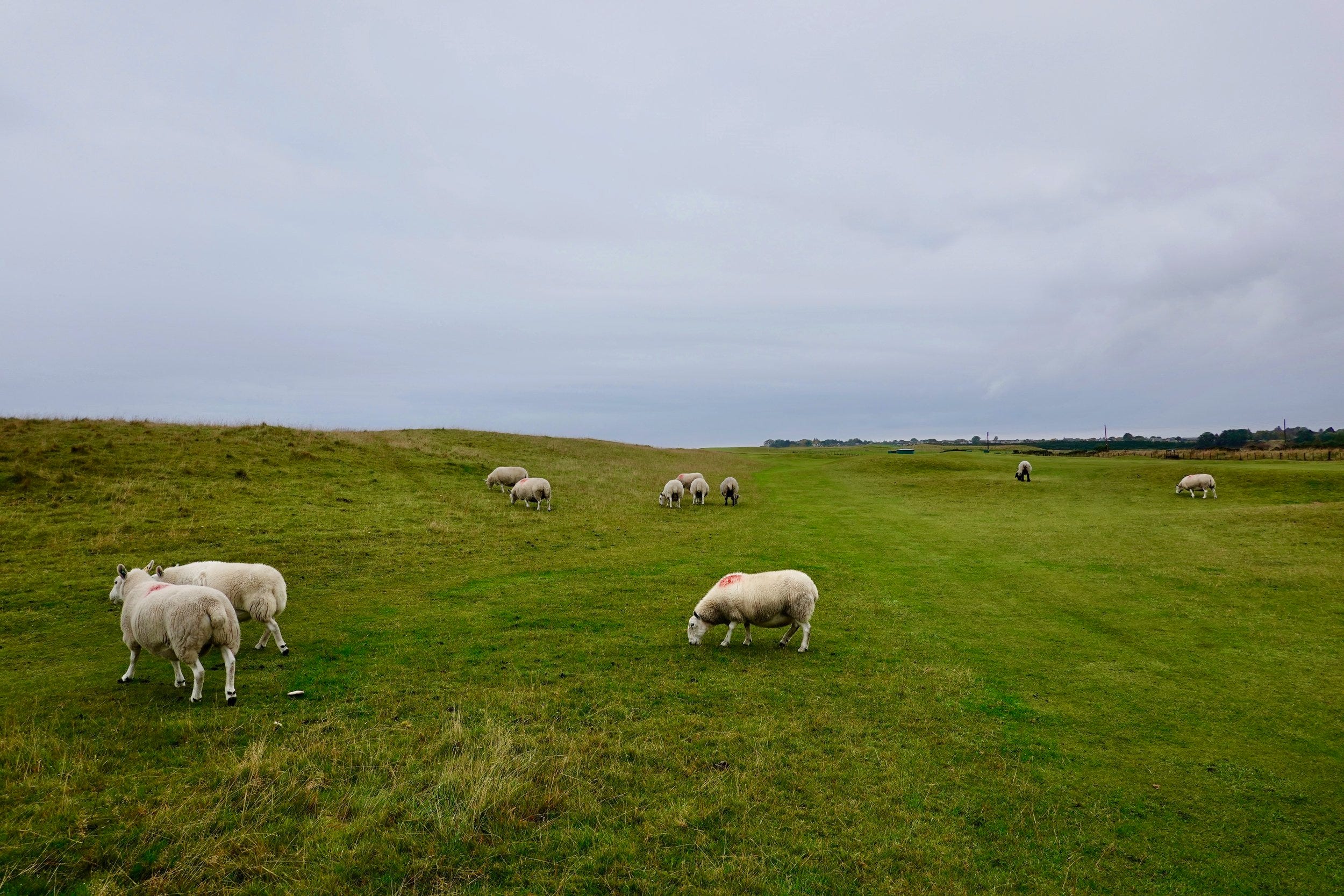
At the second hole, I met Brora’s famous livestock — a herd of Scottish cows helping themselves to the taller grass to the left of the fairway. I posed for a photo while trying not to get too close; I’ve read too many stories about tourists getting gored by buffalo at national parks. Maybe I should’ve stayed with them, because after a couple of handshake holes to open the round, Brora lets loose.
The par-4 third (447 yards from both the white and yellow tees) is perhaps Brora’s toughest: straight as an arrow from tee to green, but traveling across obscene undulations, with a deep swale dividing the two halves of the long fairway. One of Brora’s uncommonly tame greens is the hole’s only respite.
The fifth (428 yards from the white tees, 418 from the yellows) is another long par-4, but this time at full-throated madness. The Clyne Burn cuts across the fairway about 170 yards from the green, forcing all but the longest hitters to lay up and accept a mid-iron approach to a bunkerless green with a huge ridge dividing its left from its right.
And then, at the sixth, Brora comes off its hinges. The course’s first par-3, with its medium length (190 yards from the white tees, 164 from the yellows), doesn’t look like much on the scorecard. But three bunkers guard against anything short of the green: a fever dream with two ridges — one in back, one on the left — pouring down toward a perilous thumbprint on the right side. The seventh is more of the same: a medium-length par-4 (350 yards from the white tees, 340 yards from the yellows) with two dicey obstacles confronting the player along the way: a ridge cutting across some 150 yards from the green, and the burn crossing the line of play at an awkward 72 yards from the green. After hooking my approach to the left edge of the Biarritz green, my long putt hit the swale and veered left to right so hard it’d make J.D. Vance blush. My ball nestled two feet away from the hole, and somehow, I walked away with my second par in a row.
. . .